We've officially reached a point where most new job applicants have two general types of résumés. The first is the typical one-to-two page template-based résumé that's been popular for decades. The other is a more fragmented, digital, cubist-like résumé.
This second résumé stems from the many different personal fingerprints we leave on the Internet. Some are explicit and easily managed - e.g. LinkedIn and Facebook profiles. Others are semi-relevant and mainly controllable - e.g. Tweets. Finally, the least predictable and least manageable forms on Internet-based expression could potentially live on without our knowledge and control - e.g. old Instant Messenger conversations, etc.
I believe that we are seeing a rapid growth in Web-based communication that fits within the second and third categories of the second résumé - i.e. Twitter usage is steadily growing more relevant, location-based services that come with more advanced mobile technology are becoming widespread, etc. This means that it's becoming increasingly difficult to manage the second résumé. It also means that employers are increasingly relying on the second résumé as the main, true behavioral indicator.
Because of these trends, identity management will become a much bigger industry than most can foresee. Since millions of jobs will soon depend on one's Web activity, billions of dollars are at stake from controlling the second résumé.
Showing posts with label LinkedIn. Show all posts
Showing posts with label LinkedIn. Show all posts
Thursday, September 10, 2009

Sunday, May 31, 2009
Maslow's Internet - The Internet Evolved to Meet Our Needs
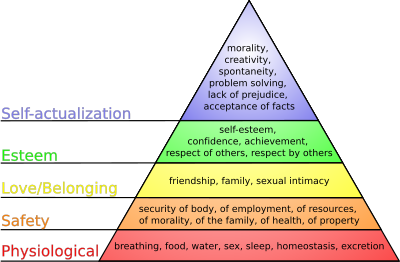 Maslow's hierarchy of needs is one of the first concepts taught in most early management and psychology classes. Although there is debate around the framework (especially around the belief that human needs are actually ranked), Maslow's hierarchy is still generally regarded as an important and valuable lens for evaluating human needs.
The gist of the theory is that humans have different levels of needs (starting at the bottom of the pyramid) and that we work to meet the bottom needs first before moving to fulfill the next set of needs. Sleep is more important than friendship, water is more important than security, etc.
When I take a non-scientific look at how the mainstream Internet has evolved - following the initial few years of the "getting to know you" period - it seems to follow the hierarchy pretty well:
- Initial communication over the Internet was relatively basic and mimicked the patterns of earlier forms of communication - facilitating basic needs. In addition, the pornography industry was one of the earliest widespread adopters of the Internet - as is usually the case with new technology.
- We soon realized that more sophisticated communication was possible over the Internet. The government began to develop simple ways of communicating with the wider population. Websites for health (WebMD), employment (Monster), financial services, and all forms of factual reference quickly multiplied.
- Real-time communication including instant messengers, chat, webcams, and now VOIP-services has further augmented our ability to communicate intimately. In addition, the mainstream acceptance of Internet dating has come to fulfill our need for Love.
- The proliferation of social networking worked to meet our esteem needs. From personal expression (MySpace) to friendly networks (Facebook) to professional networks (LinkedIn), social networking has allowed us to build a digital persona where virtual respect is coveted.
- Finally, the services that will fulfill the top needs are still in a state of fluid development. Crowdsourcing offerings like Wikipedia and Innocentive seem to be a natural way to fulfill our need for self-actualization. But there is still plenty of room and probably the greatest level of opportunity for new offerings.
Thursday, May 28, 2009
The Hoard Mentality
My friend Sam and I often discuss, argue, and validate various random concepts. I find that talking to someone different from me often inspires more interesting and valuable conclusions.
Recently we discussed the often prevalent and usually innate human need to hoard possessions. This emotional drive probably comes from various evolutionary influences - i.e. those humans who collected and saved their food or their tools managed to survive longer. This need manifests itself through many different ways in our society. Sometimes we accumulate truly valuable things like gold, jewelry, real estate, etc. Often we hoard questionably-valuable items like stocks, baseball cards, Beanie Babies, etc.
The hoarding reflex can get us in trouble. It leads to emotional bursts of overvaluation and unrealistic expectations. The hoarding need is quite possibly a contributing reason for stock bubbles, real estate bubbles, and just absurd materialistic trends - such as Beanie Babies selling for thousands of dollars.
I believe that the hoarding reflex is also a major contributor to the profound success of social networking. Websites like LinkedIn, MySpace, and Facebook allow us to easily hoard co-workers, sales leads, acquaintances, and friends. These websites let us neatly and visually quantify all the people we've collected in life. These modern tools make us feel close to a wide network of individuals and allow us to constantly grow our social stockpiles.
Are we creating unrealistic expectations of the human hoards we've accumulated and the tools that enable this collection process?
Recently we discussed the often prevalent and usually innate human need to hoard possessions. This emotional drive probably comes from various evolutionary influences - i.e. those humans who collected and saved their food or their tools managed to survive longer. This need manifests itself through many different ways in our society. Sometimes we accumulate truly valuable things like gold, jewelry, real estate, etc. Often we hoard questionably-valuable items like stocks, baseball cards, Beanie Babies, etc.
The hoarding reflex can get us in trouble. It leads to emotional bursts of overvaluation and unrealistic expectations. The hoarding need is quite possibly a contributing reason for stock bubbles, real estate bubbles, and just absurd materialistic trends - such as Beanie Babies selling for thousands of dollars.
I believe that the hoarding reflex is also a major contributor to the profound success of social networking. Websites like LinkedIn, MySpace, and Facebook allow us to easily hoard co-workers, sales leads, acquaintances, and friends. These websites let us neatly and visually quantify all the people we've collected in life. These modern tools make us feel close to a wide network of individuals and allow us to constantly grow our social stockpiles.
Are we creating unrealistic expectations of the human hoards we've accumulated and the tools that enable this collection process?
Subscribe to:
Posts (Atom)