In the world of alcoholic beverages, the bottleneck is the narrowest point of a bottle. It slows the flow of liquid. In the world of business and management, the bottleneck represents the narrowest point of a particular process. It slows the progress of development and thus constrains the whole process to its own limited capacities.
In manufacturing, the bottleneck can be a machine. In traffic, the bottleneck is a stalled car, an accident, or a construction zone. In the world of creativity and intellectual creation, the bottleneck is usually a person or a group of people.
Although potentially time-consuming and resource-intensive, upgrading a machine or clearing an accident is usually pretty straight-forward. Dealing with the human bottleneck isn't. Emotions make even broaching the subject tricky. Fixing the human bottleneck takes a lot more than just good project management - it takes a bit of friendliness, a good deal of empathy, and a touch of the Iron Fist approach.
Showing posts with label Management. Show all posts
Showing posts with label Management. Show all posts
Sunday, January 24, 2010

Sunday, November 8, 2009
Weekend Inspiration
It's refreshing to see our elected officials work over the weekend. Regardless of political beliefs, we should be encouraged by the fact that our government is willing to work through traditional days of rest in order to solve complex issues.
When the most powerful organization in the nation is willing to push through, its citizens will follow suit. In this case, the extra-effort is a component that symbolizes the importance of the overall process.
When the most powerful organization in the nation is willing to push through, its citizens will follow suit. In this case, the extra-effort is a component that symbolizes the importance of the overall process.
Tuesday, October 20, 2009
Controlled Competitiveness
I have a very competitive spirit. Sometimes I'm able to hide it and sometimes I'm not. Sometimes I'm able to control it and sometimes I'm not.
In particular, my competitive urges peak when I see a competitor making substantial progress. This competitiveness usually stirs up many different emotions - including rage, excitement, fear, jealousy, sadness, and anxiety. Without the right control, most of those emotions can be quite detrimental to my own progress and well being.
So how do I harness these powerful feelings? Usually I am able to convert my zeal into channeled ambition by taking a step back via some sort of grounding moment, through a rational approach that focuses on lessons (facts) instead of distractions (wild emotions), and by gaining perspective through direct communication with my allies. Without this control-process, I would have the fuel but not the vehicle to move forward.
Thursday, October 8, 2009
We Can Learn from NASA's Resourcefulness
NASA is planning to test whether there is water on the moon through a very creative method - by crashing a set of spacecraft and evaluating the dust that is created. Leave it to NASA to conduct a complicated analysis on the composition of the moon's soil based on a violent pounding of its surface.
Although unconventional, NASA is definitely resourceful. I strongly suspect that NASA considered and disqualified numerous other, more expensive methods, for testing the moon's surface, and that their brilliant minds came up with the "crashing" method because it is both accurate and efficient. The organization has a mandate to move mankind forward, beyond the reaches of our planet - yet NASA has a very limited budget which makes tough decision-making a necessary skill.
If other companies (e.g. the automakers) were nearly as imaginative, we'd see some very creative innovations during the hard-times of this recession. If we can learn from NASA's approach, then the constraints of time and money can be turned on their heads and converted into an interestingly unpredictable opportunity.
Tuesday, October 6, 2009
Criticism vs. Feedback
Criticism is destructive. It breeds antagonism because it stems from the wrong approach - from the focus on mistakes. Criticism could be a short-term band aid but is almost always a long-term parasite. It undercuts the future.
Feedback is constructive. It stems from the partnership perspective- from the focus on expanding the pie without sugar-coating the shit. Feedback can be painful in the short-term because it is sometimes indirect and subtle. But it is almost always a long-term seed for success. It feeds the future.
Feedback is constructive. It stems from the partnership perspective- from the focus on expanding the pie without sugar-coating the shit. Feedback can be painful in the short-term because it is sometimes indirect and subtle. But it is almost always a long-term seed for success. It feeds the future.
Thursday, October 1, 2009
The Invite
Since Internet-based products and services are much more scalable than actual real-world products and services there is usually very little natural scarcity on the supply-side of these digital goods - i.e. a website can be read almost infinitely while nearly no additional resource is consumed.
Although this makes sharing wonderfully simple, it also prevents brands from creating the "long-line effect" - i.e. from showing how wonderful their product is through the long lines of people waiting to buy. So to overcome this temporary side-effect, many companies are now utilizing the invite. After initially launching an Internet-based product or service, these companies distribute only a select number of invites.
This creates both an artificial scarcity and a collective buzz. The most important characteristic of the invite is timing - using it for too short and there is no "long-line effect"; using it for too long and potential consumers will become frustrated and might never come back. Although the usage of the invite can potentially reap benefits, it is still more of an artform than a science.
Monday, September 14, 2009
Too Minty?
It was announced today that Mint, one of the most popular financial aggregating websites, was sold to Intuit for $170 Million. Mint allows users to feed all their disparate financial information into one, handy-dandy website-based dashboard - directly aggregating bank, broker, credit card, and other financial data into one simple and useful presentation.
Mint has about 1.4 million users and fits in nicely into the Intuit suite of products - such as TurboTax and Quicken. I believe that $170 Million is a pretty good deal for Intuit as Mint hasn't even begun to tap into its real source of value - i.e. the immense amount of data that stems from having all financial data from over one million users in one database.
But I also believe that Mint's greatest potential also represents its greatest threat. With personal data management and protection growing in importance, even the sale or commercial use of anonymized personal data could quickly alienate Mint's user-base. So it seems that Mint is stuck, unable to mine its most precious commodity. I'm not sure what approach they will take but I am sure that they have a tricky path ahead.
Tuesday, September 8, 2009
Where's the Purpose?
I'm in the middle of reading a pretty solid book on the topic of advertising, management, and overall business approach: It's Not What You Sell, It's What You Stand For by Roy M. Spence, Jr. The key theme revolves around the extreme importance of the purpose and the success that stems from a clear and simple anchor that the purpose provides.
Nothing within the book is revolutionary - the reasons for having an important purpose are very compelling. So it's surprising to realize how few of the big and omnipresent companies actually seem to have a clearly defined, public-facing purpose. This is especially the case for larger and older corporations which now seem to only float on the sea of shareholder returns and net income growth.
I suspect that Lehman Brothers might have had a clear purpose at some point in time but that its anchor-less path of the last few decades led the company to the precipice of bankruptcy and dramatic death.
Wednesday, September 2, 2009
No More Time-Outs
It's difficult to pinpoint all the profound societal changes that mobile communication has triggered. But it is clear that the ability to send and receive email at any time and nearly any place has greatly shifted many norms.
Where there was once a cut-off in calling a friend or colleague or client, now Blackberry-powered email enables communication without limitation. I believe that this is particularly important for most service industries. If there is a professional serving a client, no longer is the time-of-day an acceptable excuse for a lack of communication.
I see many trying to cling to the old 9 to 5 (or 7 to 7) standards of the past. This just isn't going to work for much longer. As more and more digital natives (like myself) become both providers and consumers of services, the old rules will fade. This means that new rules for accepted behavior must be outlined and accepted - both locally and universally - and especially within teams of individuals that come from different generations.
Monday, August 17, 2009
The Tennis Lesson - Part II
The most popular form of tennis involves the one-on-one elimination tournament. The tennis player is forced into a series of solitary battles against a wide variety of competitors - from young to old, mediocre to masterful. A loss means that the tournament is over. A victory quickly brings on the next challenge.
Even a minimal analysis of tennis makes a few valuable themes clear. These lessons can be applied by others who face similar personal and professional hurdles and by those who manage those lone-operators. The main take-aways include:
Even a minimal analysis of tennis makes a few valuable themes clear. These lessons can be applied by others who face similar personal and professional hurdles and by those who manage those lone-operators. The main take-aways include:
- External factors must be managed. Tennis is played all across the world on a diverse set of courts - which are made up of grass, clay, etc. A player's level of success often varies widely depending on the environment.
- Morale can quickly affect the outcome. A single "bad" officiating decision or other conflict can instantly derail a tennis player. The lone competitor doesn't have the benefit of teammates or peers to buffer or refocus anger. His own emotions can fester and grow. His mind works without the ability to share thoughts or fears with a coach during the match.
- A complete understanding and comfort with one's tools is required. Many tennis players have experienced a significant decline in their success after switching rackets. The lone competitor reacts disproportionately to a change in his toolset. The racket represents something that a player can completely control - a way to compensate for the environment or emotional outbursts.
- The right preparation is vital. Because the smallest on-court decisions can lead to victory or defeat, tennis players spend years practicing. They develop the necessary physical skills and the mental abilities to properly react to different scenarios. Because the game is so fast and so involved - preparation is usually far more important than talent.
Sunday, August 16, 2009
The Tennis Lesson - Part I
Sports are often used as models for real life. Since we frequently derive useful lessons from sports, these competitive challenges can serve as a microcosm for actual experiences - e.g. the importance of momentum within small teams is beautifully and repeatedly illustrated in basketball. Sports such as football, baseball, and even golf are the usual sources for the inspiration of these analogies. Although not commonly analyzed, I believe that tennis also has many valuable lessons to offer.
Tennis is a major global spor t, but its popularity fluctuates wildly in the United States. Tennis in the U.S. usually gains limited prominence during particular times of the year when important and/or local tournaments occur. It also reaches widespread appeal when a particular U.S. tennis-star achieves a certain degree of success. Thus tennis doesn't usually come to mind as the prime candidate for useful illustrations of real world examples.
But tennis offers a very valuable venue for building arguments because, unlike any other sport, it mimics a particular real world scenario - it presents a simple model to describe and analyze the solitary competitor. This protagonist is completely alone, where communication with the coach (or caddy) isn't allowed. This hero faces one significant challenge at a time - the live and ever-changing opponent of the day.
Such a scenario is often seen in business and social life. For instance, the solitary salesman often faces a very similar endeavor - tackling one potential sale at a time while alone in the field. Other such circumstances might occur in the line of duty for police officers, soldiers, consultants, spies, etc. Thus the explanatory power of tennis is both relevant and important.
Tomorrow I will describe a few simple but valuable lessons that can be quickly learned from the game of tennis.
Tennis is a major global spor
 t, but its popularity fluctuates wildly in the United States. Tennis in the U.S. usually gains limited prominence during particular times of the year when important and/or local tournaments occur. It also reaches widespread appeal when a particular U.S. tennis-star achieves a certain degree of success. Thus tennis doesn't usually come to mind as the prime candidate for useful illustrations of real world examples.
But tennis offers a very valuable venue for building arguments because, unlike any other sport, it mimics a particular real world scenario - it presents a simple model to describe and analyze the solitary competitor. This protagonist is completely alone, where communication with the coach (or caddy) isn't allowed. This hero faces one significant challenge at a time - the live and ever-changing opponent of the day.
Such a scenario is often seen in business and social life. For instance, the solitary salesman often faces a very similar endeavor - tackling one potential sale at a time while alone in the field. Other such circumstances might occur in the line of duty for police officers, soldiers, consultants, spies, etc. Thus the explanatory power of tennis is both relevant and important.
Tomorrow I will describe a few simple but valuable lessons that can be quickly learned from the game of tennis.
Monday, August 10, 2009
Get Ready for the Tangible Backlash - Part II
So now that I've argued that real things will make some sort of significant comeback, what does that mean for businesses new and old?
- There will be a breakout collectible item that will hit across generational groups and will become a fast-burning yet Billion Dollar opportunity - think the new Beanie Babies.
- The concepts of pure and rare will become closely tied to the real - such as live gatherings, live music, live comedy.
- A premium will be accepted for good design - we already get this with brands such as Apple and and Method, but will also get it in new and unexpected places.
- Anything vintage will be valuable - we already see this with Vinyl music and we'll see it with film, art, toys, design, and other creative outlets that have been recently consumed by the digital domain.
- The real estate and automobile industries will experience a rapid comeback - beating all expectations - what's more real than the home and the ride?
All of these predictions are quite positive and will benefit from riding the economic-recovery wave. They represent opportunities large and small that will offer a significant, yet temporary revival for all that is tangible.
Wednesday, August 5, 2009
Do Social Networks Stifle Innovation?
It's traditionally accepted that radical innovation is more likely to occur under certain social scenarios - where young, undeveloped ideas are given time to grow and to be refined. It's thus believed that early sharing and the potential for early criticism of rough ideas may stop perfectly good radical innovation in its tracks - that social networks that support this instant criticism are bad for innovation. The August 1, 2009 issue of one of my favorite magazines, New Scientist, talks about this phenomenon and even goes so far as to recommend re-engineering of massively popular, Internet-based social networks - or even the prevention of potential innovators from using such instant-communication tools.
I'm not convinced that modern social networks need major change in order for groundbreaking inventions to occur. Building barriers to instant interaction might diminish some groupthink by protecting innovators, but it would also diminish the collective intelligence and communication that is enabled through new, digital social networks. I believe that the benefits of open and fast communication still significantly outweigh any pressures to conform. I also think that we've reached a level of Internet-diversity where radical thinking is near-equally supported and criticized by the masses - no matter how far-fetched the idea.
I'm not convinced that modern social networks need major change in order for groundbreaking inventions to occur. Building barriers to instant interaction might diminish some groupthink by protecting innovators, but it would also diminish the collective intelligence and communication that is enabled through new, digital social networks. I believe that the benefits of open and fast communication still significantly outweigh any pressures to conform. I also think that we've reached a level of Internet-diversity where radical thinking is near-equally supported and criticized by the masses - no matter how far-fetched the idea.
Sunday, May 31, 2009
Maslow's Internet - The Internet Evolved to Meet Our Needs
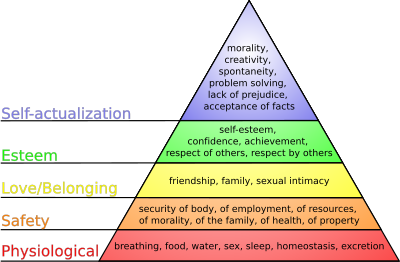 Maslow's hierarchy of needs is one of the first concepts taught in most early management and psychology classes. Although there is debate around the framework (especially around the belief that human needs are actually ranked), Maslow's hierarchy is still generally regarded as an important and valuable lens for evaluating human needs.
The gist of the theory is that humans have different levels of needs (starting at the bottom of the pyramid) and that we work to meet the bottom needs first before moving to fulfill the next set of needs. Sleep is more important than friendship, water is more important than security, etc.
When I take a non-scientific look at how the mainstream Internet has evolved - following the initial few years of the "getting to know you" period - it seems to follow the hierarchy pretty well:
- Initial communication over the Internet was relatively basic and mimicked the patterns of earlier forms of communication - facilitating basic needs. In addition, the pornography industry was one of the earliest widespread adopters of the Internet - as is usually the case with new technology.
- We soon realized that more sophisticated communication was possible over the Internet. The government began to develop simple ways of communicating with the wider population. Websites for health (WebMD), employment (Monster), financial services, and all forms of factual reference quickly multiplied.
- Real-time communication including instant messengers, chat, webcams, and now VOIP-services has further augmented our ability to communicate intimately. In addition, the mainstream acceptance of Internet dating has come to fulfill our need for Love.
- The proliferation of social networking worked to meet our esteem needs. From personal expression (MySpace) to friendly networks (Facebook) to professional networks (LinkedIn), social networking has allowed us to build a digital persona where virtual respect is coveted.
- Finally, the services that will fulfill the top needs are still in a state of fluid development. Crowdsourcing offerings like Wikipedia and Innocentive seem to be a natural way to fulfill our need for self-actualization. But there is still plenty of room and probably the greatest level of opportunity for new offerings.
Subscribe to:
Posts (Atom)