Showing posts with label Marketing. Show all posts

Wednesday, January 15, 2014

Nostalgic Capital: Money, Memories, & Miller Lite

nostalgic - [no-stal-jik nuh‐], adjective
experiencing or exhibiting nostalgia, a sentimental or wistful yearning for the happiness felt in a former place, time, or situation.

capital - [kap-i-tl], noun

the wealth, whether in money or property, owned or employed in business by an individual, firm, corporation, etc.
an accumulated stock of such wealth.

nostalgic capital - [no-stal-jik kap-i-tl], noun

the stored nostalgic value of some person, place, or thing.
the total amount of nostalgia inspired by some person, place, or thing.
 

SUMMARY


Nostalgia is a bittersweet longing and emotional appreciation for the past. It is often associated with and triggered by a particular concept, product, event, person, or place that we experienced in some personal way, either directly and/or through the prism of media - e.g. through newspapers, television, internet, etc. 
 
The Beatles, Credit: UPI Telephoto via Wikipedia
Most importantly, nostalgic emotions are also a motivator for various actions. We take pictures in the present to meet our nostalgic needs in the future. We listen to an Elvis, The Beatles, Led Zeppelin, Guns N' Roses, or Nirvana album as a way to scratch a nostalgic itch. We select certain brands, follow certain actors, or even live in certain places because of nostalgic impulses. The best nostalgic indulgences are pleasant and fulfilling. Nostalgia is a very powerful emotion.

Capital is stored value. Most often, it refers to resources such as money, land, or various commodities. But it can also represent significantly less tangible concepts - such as human capital, intellectual capital, or even emotional capital. More capital is (nearly) always better than less capital. One form of capital can usually be traded for another form of capital.


Nostalgic Capital is the accumulated nostalgic value of some person, place, or thing - i.e. by the nostalgic asset. It represents the total nostalgic emotion that a nostalgic asset evokes, either from an individual or a group of individuals - e.g. from me, you, the class of 2003 from New York University, the city of Detroit, etc. 


Nostalgic capital can appreciate or depreciate in value. It can be traded for other forms of capital - such as money, time, effort, etc. The concept of nostalgic capital is important for marketers, product developers, producers (music, film, television, etc.), and all others who create something that is meant to be consumed - i.e. it is a vital concept for most modern professionals. Yet it is rarely studied and often misunderstood.

The purpose of this article is to introduce the concept of nostalgic capital - particularly as it relates to how new products are designed, developed, and marketed. The aim is not to depict a comprehensive study or to establish a definitive piece, but to intelligently begin a conversation about this important topic and to present a broad foundational theory.
 

THEORY


The process of nostalgic capital creation and appreciation follows the familiar pattern of the S-Curve. It differs from the traditional technology life-cycle in that the value of nostalgic capital never dips below zero and exhibits a more gradual depreciation in value.

Nostalgic Capital Curve, Credit: Vladimir Vukicevic

The Establishing Event represents the beginning of nostalgic capital creation. It is the first time that a person, place, or thing enters the consciousness of an individual or a group of individuals. An establishing event can be the initial release of a film, the unveiling of a new product, the first visit to a new city, etc. 

The establishing event is rarely one moment in time. It is a range of time during which people absorb the person, place, or thing for the first time - while there is still a level of exciting novelty associated with the nostalgic asset. The establishing range can vary significantly, based on the concept being evaluated. For instance, the establishing event range for The Beatles can be reasonably defined to be up to ten years long (from 1960 to 1970), while the establishing event range for Abbey Road (the 11th studio album by The Beatles) is likely between 6 and 12 months in 1969/1970. Even designs, fonts, and overall look-and-feel can fall within the Nostalgic Capital Curve.

The Gradual Appreciation period begins immediately following the establishing event. As time begins to pass, memory begins to overtake reality. The asset associated with the nostalgic emotion begins to gain nostalgic capital. No matter what the nostalgic asset is - i.e. what its level of perceived quality at the time of establishment is accepted to be - nostalgic capital will begin to accrue. The absolute value of the total nostalgic capital will vary greatly among different concepts - e.g. the first Star Wars movie will have a significantly different absolute level of nostalgic capital from Paris Hilton's mid 2000's TV series, The Simple Life.

Star Wars, Original Poster Design
Rapid Appreciation of the nostalgic capital seems to begin 10 to 15 years following the establishing event and lasts 5 to 10 years. This period often coincides with a shift in social generations - i.e. as a new cohort of people begins to grow and as the previous generations move down the temporal totem pole. Since World War II, this has occurred approximately every 20 years throughout most of the world.

The Nostalgic Apex period occurs about 20 to 30 years following the establishing event and lasts between 10 and 15 years - depending on different variables. This peak period represents the greatest opportunity for marketers, product developers, entrepreneurs, producers, and other creators looking to capitalize on the peak of nostalgic emotion evoked by the nostalgic asset.

The nostalgic apex often represents a comprehensive and renewed embrace of a particular concept. This period tends to highlight the positive aspects of the nostalgic asset. It is nostalgia at its grandest.

The Depreciation Period immediately follows the nostalgic apex. It is the gradual de-emphasis of the particular concept. It is a slow cultural decline in significance and nostalgic value. This period often sees other persons, places, or things having a larger and more prevalent nostalgic role in society. It also coincides with the gradual death of the generation which experienced the initial establishing event in the most personal and direct way. It is a period of memory decline and the physics of decay.

As more people no longer have any direct connection to the establishing event, the Historical Period begins. Nostalgia becomes history. Emotion is slowly removed as a more objective perspective is applied. Past concepts are cemented into archives and consistent narratives.

CASE STUDIES


Miller Lite - The Superficial Approach

Miller Lite is one of the first mainstream light beer brands to be widely sold in the United States. The brand was introduced in 1975 and was widely promoted upon launch by numerous celebrities and notable athletes. As the brand has evolved, so has its packaging and overall presentation.


New/Old Miller Lite Can
Since the widespread acceptance of light beers, the market for alcoholic beverages has significantly evolved. New competition within light beers, in addition to a massive surge of other options - including craft beers, spirits, wines, etc. - has made differentiation more difficult. As a new marketing and product differentiation strategy, Miller Lite has re-introduced its original packaging as part of a limited-time "The Original" campaign. 

This obvious attempt to leverage peaking nostalgic capital is relatively simple and superficial. But it represents a potentially lucrative marketing opportunity for many long-established consumer brands such as Miller Lite.

Instagram - The Integral Approach

Instagram is an extremely popular photo-creation, photo-filtering, and photo-sharing application that represents a powerful example of the value of nostalgic capital in product design. Launched in 2010, Instagram quickly gained users (over 100 million by 2012) in a crowded marketplace of established and emerging photo-based applications.

Instagram's key point of differentiation is seen in its photo-sizing and photo-filtering features. The application confines photos to a square shape - reminiscent of classic and highly popular Kodak and Polaroid formats from the 1970's and 1980's. In addition, Instagram offers numerous evocative photo filters that can easily be applied to personal images. The filters enable users to age the look-and-feel of images through color distortion, sharpness adjustment, and other neat changes.

The Instagram Difference, Credit: I, Sailko via Wikipedia
Instagram brilliantly incorporated the concept of nostalgia as an integral component into its product design and key features. A large part of the application's rapid adoption is due to the utilization of nostalgic assets (the look-and-feel of photos) during their nostalgic apex (25-35 years following original adoption of that look-and-feel). Instagram was sold to Facebook (its largest competitor) in April 2012 for around $1 Billion in cash and stock - well in advance of the depreciation period for its nostalgic assets, i.e. its product differentiation features.

River West Brands - The Complete Approach

Specialty brand and marketing agencies are emerging that focus purely on acquiring and monetizing no-longer active brands. One such company, River West Brands, purchases dead brands purely for their nostalgic capital value. River West's founder, Paul Earle, has explicitly based the company's complete strategy on the powerful concept of nostalgia.

As quoted from the New York Times: "...when Earle talks about consumer memory, he is factoring in something curious: the faultiness of consumer memory. There is opportunity, he says, not just in what we remember but also in what we misremember." From this, it is evident that Earle derives the financial valuation for the brands he purchases from nostalgic capital value.

The Coleco Vision Console, Credit: Evan-Amos via Wikipedia
River West Brands has purchased numerous brands, including Brim Coffee and Coleco Games. Some of these brands have been successfully relaunched, leveraging the nostalgic apex period to generate new profit from old, seemingly-dead assets.

CONCLUSION


Nostalgic capital is a valuable concept that is important for marketers, product developers, producers, and all those who create. Both individuals and organizations can benefit from understanding the principles of nostalgic capital. 

The theory of nostalgic capital can be applied in different ways - from the superficial to the integral to the complete approach. Businesses can leverage nostalgic capital and the nostalgic capital curve in order to boost sales, introduce new products, or even as the foundation for strategic positioning.

Nostalgic capital and the nostalgic capital curve represent an emerging theory that should be studied further. Nostalgic capital may offer us the opportunity to unlock significant economic value via an approach that leverages a generally positive reservoir of emotions.


-----


OPEN QUESTIONS


How can nostalgic capital be objectively measured?

What variables determine the peak of nostalgic capital? 

What variables determine the length of the nostalgic apex period? 

How does new technology and the proliferation of the internet impact the nostalgic capital curve?

How does the concept of fauxstalgia fit within this theory?

How can we encourage the positive application of nostalgic capital concepts?

Wednesday, November 25, 2009

The Lifestyle of Things

No longer are things just things. All sorts of objects are now marketed as an integral component of a wider, complementary lifestyle. The type of refrigerator you buy, the type of car you drive, and especially the type of home you live in signal, both to yourself and to the world, exactly what type of person you are. All of these purely inanimate things are now both the cause for and the result of a particular life path.

Although advertisers have leveraged this reality for some time now, the standard approach has been to link particular products to one's level of wealth, to one's material status. Today, a car can signal wealth - but it can also signal an outgoing lifestyle, a conservative lifestyle, an urban lifestyle, a rural/rugged lifestyle, etc. The same goes for nearly all widely advertised objects - from toilet paper to personal jets.

Source: Jeep.com

This is neither good nor bad. It is part of the materialistic culture which still dominates our society. But it does present both a challenge and an opportunity to those looking to produce and market virtual goods - the backbone of new economic models developing on the web.

Sunday, November 15, 2009

Car Shopping

I had the "pleasure" of shopping for a car this weekend. Although the stereotype of dealing with the (used) car salesman is somewhat overblown, it is still a pretty accurate depiction of what to expect.

Car dealership ads are still very much misleading and are meant to purely bring the buyer through the front door. Financial "details" in these ads can be molded to fit most desired realities. When dealing with the salesman, actual lying never takes place. Important facts that could diminish the value of a particular car are not mentioned, skimmed over, or left to be interpreted by the buyer.

Overall the experience was a mixed bag of useful hands-on shopping and bitter aftertaste of shady salesmanship. It's hard to believe that some organization hasn't completely put the old system to rest by offering a completely transparent car-buying experience.

Thursday, November 12, 2009

Fresh Ads

I love examples of creativity and innovation making old forms of media new and exciting. This recent showcase of outdoor advertising depicts just that. It is an obvious example of ingenuity making an old medium fresh, fun, and a bit surprising.

Monday, November 9, 2009

Fauxstalgia

I'm fascinated by the power of nostalgia. This omnipresent emotion can distort and even reshape the past, present, and future. It is a comforting blanket that can be explicit or subtle.

Almost as interesting is a concept much more unusual but maybe comparably prevalent: fake nostalgia or fauxstalgia. Fauxstalgia is similar to regular nostalgia in that it fosters a sense of comfort and happiness. But what makes fauxstalgia so unusual is that it creates a strong feeling for a time or place that we never actually encountered. For example, I occasionally feel nostalgic (fauxstalgic) for the Roaring Twenties or the Atomic Age of the 1950s. I was born well after these eras.

Fauxstalgia is what turns Mad Men, Indiana Jones, and Gone With the Wind into hits. While nostalgia is a reflex, fauxstalgia comes from training - through pop culture and mass media. It is a projection of emotional perfection. Triggers of fauxstalgia are very powerful.

Wednesday, November 4, 2009

The Blue Shirt Problem

I went to Macy's today with the goal of purchasing a blue dress shirt. Blue is a standard, widely accepted color for young professionals such as myself. Because of this fact, there were at least 30 different types of purely blue shirts. They were all quite similar but also somewhat different - with slightly different patterns, textures, shades, shapes, etc.

By now, most marketers know that too much choice can be counterproductive - that the customer gets overwhelmed and may choose nothing. I definitely felt this phenomenon begin to affect my decision-making process - since the energy needed to make a selection was nearly greater than the immediate benefit of getting a new shirt.

I finally ended up selecting one shirt. But the choice was based on nearly pure luck and a conscious decision to not waste any more time comparing the different choices. In a world where time is more important than a physical good, how can digital goods even compare?

[To Be Continued]

Thursday, October 29, 2009

The Right Mix of Fun and Fear

A holiday that lets us become someone else for a few hours seems like an obviously popular concept. Who wouldn't want to be Batman or Hillary Clinton for the night?

A holiday popularized by ghouls, ghosts, witches, goblins and other evil-doers is a less likely success. In real life, most of us don't want to be haunted, taunted, or scared.

So how does Halloween find the right mix of fun and fear? Candy. Whether young or old, candy is sweetness - both literally and symbolically. Candy puts us at ease and solidifies Halloween as a lighthearted event. Symbols such as candy are very powerful - that's one of the reasons why sweets are a part of nearly every popular holiday.

Tuesday, October 13, 2009

Twitter Bots Kill Reputation

Twitter is clearly a fascinating phenomenon. It allows for evolutionary human traits, idiosyncrasies, absurdities, etc. to be clearly and easily displayed in 140 characters or less.

In fact, it's much more than just those 140 characters that make up a Twitter persona. The other main qualities any Twitter user has are the number of people that user follows and the number of people that follow the user. The prior describes overall engagement; the latter signifies overall popularity.

Companies have grasped these concepts rather quickly and now strive to make their Twitter personas followed by thousands of adoring fans. But what many of these fair-minded companies have realized is that it's usually pretty difficult to quickly manufacture followers. So various Twitter-"marketing" companies have sprouted touting the ability to miraculously provide thousands of fans in only a few days - for a small fee of course.

As we all know, when something valuable comes for only a small fee then things are usually not as they appear. These thousands of new fans are often bots - fake Twitter personalities created for the sole purpose of boosting the follower equation, for making it seem, at first glance, that someone or something is very popular.

(Un)fortunately, these types of shenanigans are usually quite transparent. The bots are not very good about posting realistic pictures in their profiles or communicating in natural ways - i.e. they can be spotted from a mile away. This doesn't really hurt the "marketing" companies that provide these fake masses, but instead damages the reputation of those seemingly honest companies that have these strange supporters.

So today, when I realized that a company that I've been following for months and that I felt was quite honest had gained over 35,000 fans in a week, something smelled fishy. And when I dug a little deeper I found a lot of fish - in the form of a reputation-killing digital mob. How sad.

Sunday, October 4, 2009

Local Should Be Everywhere

When I was a child growing up in New York City I loved to go to the movies on a regular basis. At that time, the most convenient way to find movie listings was to go to the street corner and pick up a copy of the Village Voice (a local newspaper), quickly flip to the back while trying to avoid the many ads, and manually find the movie theatres of interest.

Although the ads in the Village Voice were frequently annoying, they were usually geographically relevant. The local restaurants, nail salons, and dry cleaners would all advertise their establishments.

Today, movie listings are only a click away. But finding a relevant theatre via Fandango still involves putting in a local identifier - the zip code. Although I receive a list of local theatres, I don't see any ads for local establishments - instead I see ads for big, national brands. This means that the most current technology for finding movie information doesn't leverage the powerful knowledge that newspapers have been able to leverage for decades - the ability to geographically place the audience.

Clearly the Internet is still an evolving medium, but geo-location and related targeted advertising seems like an easy win. The long tail of small and medium local-establishments might provide that marketing boost that many websites are in dire need of.

Thursday, October 1, 2009

The Invite

Since Internet-based products and services are much more scalable than actual real-world products and services there is usually very little natural scarcity on the supply-side of these digital goods - i.e. a website can be read almost infinitely while nearly no additional resource is consumed.

Although this makes sharing wonderfully simple, it also prevents brands from creating the "long-line effect" - i.e. from showing how wonderful their product is through the long lines of people waiting to buy. So to overcome this temporary side-effect, many companies are now utilizing the invite. After initially launching an Internet-based product or service, these companies distribute only a select number of invites.

This creates both an artificial scarcity and a collective buzz. The most important characteristic of the invite is timing - using it for too short and there is no "long-line effect"; using it for too long and potential consumers will become frustrated and might never come back. Although the usage of the invite can potentially reap benefits, it is still more of an artform than a science.

Sunday, September 13, 2009

The Sunday Night Blues

The Sunday Night Blues are ingrained into most Western World (and beyond) individuals from the early days of pre-school. This feeling of melancholy stems from the end of the weekend and the impending weight of the upcoming school/work week. It is one of the oldest constantly reappearing emotions we feel - an emotion that is nearly identical at age 6, at age 16, at age 26, at age 50, and probably all the way until retirement.

This unpleasant state begins as the sun sets on a regular (non-holiday enhanced) weekend. It fosters strange acts - i.e. giving in to bad television shows or indulging is unhealthy meals. It leads us to postpone sleep for as long as possible in order to prolong the freedom of the weekend. The emotion mutates into apprehensive submission and then finally into the eventual flow of a high-performing study/work week.

For those sufficiently crass and opportunistic, the Sunday Night Blues offer a chance to reach a different emotional state in target consumers. For instance, I suspect that vacation-themed advertisements might reach a more receptive and accepting audience on Sunday nights. But for those looking to make the world a happier place, the Sunday night timeslot offers a great chance for positive innovation and design - for the opportunity to create the solution to a major collective downer.

Thursday, September 3, 2009

The QWERTY Opportunity

The QWERTY keyboard has been around since the late 1800s. It is still the dominant format for most keyboards, now primarily seen on desktop computers, laptops, netbooks, and smartphones. Although the QWERTY was somewhat intuitively designed, by placing letters in different positions based on frequency of usage, it is not considered the most optimal model for a writing interface.

So why does QWERTY still dominate? It is still by far the most popular format because of the self-reinforcing cycle of usage-and-training - i.e. because QWERTY is so universal most new typists learn to type on QWERTY and thus demand it in the future, this makes QWERTY even more universal. The same cycle can be seen in hundreds of examples every day: the steering system for cars, the computer mouse, the telephone, etc.

For a new system to replace the old and well established way of doing things, it needs to be more than just better. It must be so much better that it breaks the usage-and-training cycle. This is clearly a tall order but also a very lucrative opportunity. That's why so much money continues to be spent (wasted?) on improving technologies such as voice-recognition and touch-screens. The value of becoming the new universal standard is enormous.

Thursday, August 27, 2009

Don't Mess With Fresh

Recently I've begun using scentless detergent. I'm sure that it leaves my clothes as clean as the scented variety but something is missing. Clearly it's that fresh feeling that stems from the chemically-induced smell of most common detergents.

So why does it matter? It matters because certain products have unalienable characteristics ingrained in their being. If these traits were to be fiddled with or disassociated from that product, some real or perceived measure of quality would be lost. If a new car came without that magnificent "new-car" smell, a large portion of the expected emotional fulfilment would be erased.

This is both an opportunity and a threat. When marketers can tap into and magnify these special traits, a new level of customer satisfaction might come about. If those expected quality-characteristics are disturbed, then a disproportionately negative response might arise. I won't make the same mistake again - my next detergent selection will have that familiarly pleasant artificial fresh scent.

Wednesday, August 26, 2009

What do you want to eat today?

In the past few years, New York City has experienced a very interesting fragmentation of fast-food (McDonald's, Wendy's, etc.) and quick-food (Subway, Pizza Hut, etc.). For example, we now have five or six different sandwich-shop chains - each catering to a slightly different customer-base.

This fragmentation and thus greater choice has been good to the quick-food connoisseur like myself. But it has left me pondering at what point does this niche-ification become unsustainable - i.e. when is the target market too small to maintain profitability?

The answer probably depends most heavily on population density - which can be easily measured. But there also seems to be a fair amount of chance involved. This uncertainty stems from overall food trends. The smaller the niche, the more susceptible these new establishments are to the whims of the crowds. A restaurant serving only vegetarian sandwiches has a smaller chance of surviving a meat-loving cuisine trend than a multi-ethnic Diner. I'm not so sure that new restaurant entrepreneurs consider or even understand this added risk.

Monday, August 24, 2009

How do you spell that?

I've been thinking about brand names a lot lately, both within the context of domain names, as I wrote about on Saturday, and within the wider realm of popular appeal.

There seems to be a general tradeoff between abstraction and defined description. Abstract brand names, such as Twitter and Google, are usually quite interesting and can be mysterious. Sometimes they are difficult to spell or initially remember. But once entered into personal memory, these types of names are usually more difficult to forget. Descriptive brand names, such as General Motors or American Airlines, instantly express the offered product/service. They can be quickly explained but aren't necessarily memorable.


The Internet is riddled with the full spectrum. In many ways, the product/service dictates what spot on the spectrum to hit. But in the end, the choice of brand name most likely depends on the combinations of the entrepreneur's personal taste and the overall branding trends at the time of the company's conception.

Monday, August 10, 2009

Get Ready for the Tangible Backlash - Part II

So now that I've argued that real things will make some sort of significant comeback, what does that mean for businesses new and old?
  • There will be a breakout collectible item that will hit across generational groups and will become a fast-burning yet Billion Dollar opportunity - think the new Beanie Babies.
  • The concepts of pure and rare will become closely tied to the real - such as live gatherings, live music, live comedy.
  • A premium will be accepted for good design - we already get this with brands such as Apple and and Method, but will also get it in new and unexpected places.
  • Anything vintage will be valuable - we already see this with Vinyl music and we'll see it with film, art, toys, design, and other creative outlets that have been recently consumed by the digital domain.
  • The real estate and automobile industries will experience a rapid comeback - beating all expectations - what's more real than the home and the ride?

All of these predictions are quite positive and will benefit from riding the economic-recovery wave. They represent opportunities large and small that will offer a significant, yet temporary revival for all that is tangible.

Sunday, August 2, 2009

Functional Flaws

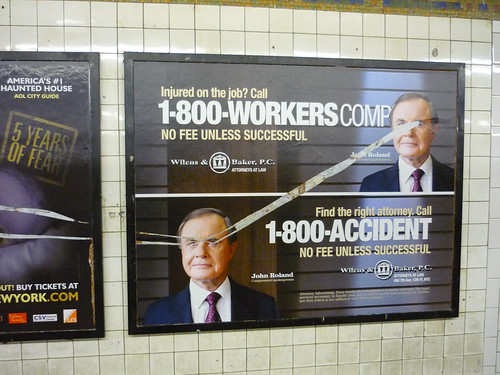
Riding the subways of New York is always a unique experience. It runs the gamut of wonderful, inspiring, depressing, disgusting, repulsive, and dangerous. It can also be quite cathartic. Part of the experience is viewing the diverse set of both intentionally and unintentionally absurd posters plastered across nearly every station and inside nearly every train - primarily serving as advertisements.

Today I realized that I've grown immune to actually noticing most of the posters. The promise of perfection is no longer an effective attention-getter. I do notice those posters which are in some way flawed, imperfect, or clearly vandalized. If something is out of place, unexpected, or obscene, I will usually take an extra second to see which unfortunate brand has been affected.

This is probably neither positive nor negative for the advertisers. But it does indicate that the dirty and deranged is still unexpected and eye-catching in certain environments. Flaws will probably force people to take notice, but the impressions may be counter-productive for the brand. Some companies may benefit from intentional flaws if all they seek is attention.

Subway poster Vandalism Art, originally uploaded by Mark_Baratelli.

Wednesday, June 24, 2009

From Steel to Gold - Part III

So what? Why does the whole concept of the Utility-Luxury grid really matter? Well it's important because a product's placement on the grid influences nearly all of its characteristics.

I'll take the liberty to apply a slightly modified version of Four Ps model to demonstrate this fact:

  1. Product. The physical characteristics of a product determine Utility-Luxury placement, perception, and expectations. More luxurious products are often associated with quality and durability - whether this is factual is irrelevant. On the other hand, silly putty isn't expected to last forever.
  2. Price. Price serves as both an actual result of the market, but also as a signal - often a higher price screams that a product is really useful/necessary, that it's very luxurious, or both.
  3. Placement. This usually refers to the physical or digital point of sale. I often expand the definition to include customer placement - i.e. segmentation and targeting. A new Mercedes is never sold to low-income individuals via a multi-brand car dealership in an inner-city setting.
  4. Promotion. The public image of a product is the most direct way of communicating where the product is on the Utility-Luxury grid and where it wants to be.

The Four Ps are the vital components that make up a product or service. The past, present, and future placement of a particular offering along the Utility-Luxury grid directly influences and is influenced by the product's particular characteristics.