I'm fascinated by the power of nostalgia. This omnipresent emotion can distort and even reshape the past, present, and future. It is a comforting blanket that can be explicit or subtle.
Almost as interesting is a concept much more unusual but maybe comparably prevalent: fake nostalgia or fauxstalgia. Fauxstalgia is similar to regular nostalgia in that it fosters a sense of comfort and happiness. But what makes fauxstalgia so unusual is that it creates a strong feeling for a time or place that we never actually encountered. For example, I occasionally feel nostalgic (fauxstalgic) for the Roaring Twenties or the Atomic Age of the 1950s. I was born well after these eras.
Fauxstalgia is what turns Mad Men, Indiana Jones, and Gone With the Wind into hits. While nostalgia is a reflex, fauxstalgia comes from training - through pop culture and mass media. It is a projection of emotional perfection. Triggers of fauxstalgia are very powerful.
Monday, November 9, 2009

Sunday, November 8, 2009
Weekend Inspiration
It's refreshing to see our elected officials work over the weekend. Regardless of political beliefs, we should be encouraged by the fact that our government is willing to work through traditional days of rest in order to solve complex issues.
When the most powerful organization in the nation is willing to push through, its citizens will follow suit. In this case, the extra-effort is a component that symbolizes the importance of the overall process.
When the most powerful organization in the nation is willing to push through, its citizens will follow suit. In this case, the extra-effort is a component that symbolizes the importance of the overall process.
Thursday, November 5, 2009
One Piece at a Time
I had the privilege of going to WD-50 tonight. It is an extremely wonderful restaurant in the Lower East Side of Manhattan.
The whole concept behind the menu focuses on the deconstruction of popular meals - like scrambled eggs - and using the basic ingredients to create brand new adventures. We could all use this approach from time to time.

The whole concept behind the menu focuses on the deconstruction of popular meals - like scrambled eggs - and using the basic ingredients to create brand new adventures. We could all use this approach from time to time.
The scrambled egg ravioli, charred avocado, and hamachi.
Wednesday, November 4, 2009
The Blue Shirt Problem
I went to Macy's today with the goal of purchasing a blue dress shirt. Blue is a standard, widely accepted color for young professionals such as myself. Because of this fact, there were at least 30 different types of purely blue shirts. They were all quite similar but also somewhat different - with slightly different patterns, textures, shades, shapes, etc.
By now, most marketers know that too much choice can be counterproductive - that the customer gets overwhelmed and may choose nothing. I definitely felt this phenomenon begin to affect my decision-making process - since the energy needed to make a selection was nearly greater than the immediate benefit of getting a new shirt.
I finally ended up selecting one shirt. But the choice was based on nearly pure luck and a conscious decision to not waste any more time comparing the different choices. In a world where time is more important than a physical good, how can digital goods even compare?
[To Be Continued]
Tuesday, November 3, 2009
Late Night Letdown
In the late 1980s/early 1990s, late night television was exciting. It was unpredictable, innovative, and buzz-worthy. Today, late night TV (Leno, Conan, Fallon, Letterman, etc.) has lost its charm. I'm not sure when it happened, but I am sure that this form of entertainment has lost most of its significance as an important cultural movement.
The expanded variety of entertainment that comes from cable television and the Internet has probably diluted the reach of late night. But I believe the main cause for the decline in relevance stems from a decline in the taboo-factor. No longer is network television-based late night comedy the most exciting form of nearly free entertainment. No longer is any unpredictability associated with the corporate machine that drives the typical plug-the-movie/album format of these stale shows.
The expanded variety of entertainment that comes from cable television and the Internet has probably diluted the reach of late night. But I believe the main cause for the decline in relevance stems from a decline in the taboo-factor. No longer is network television-based late night comedy the most exciting form of nearly free entertainment. No longer is any unpredictability associated with the corporate machine that drives the typical plug-the-movie/album format of these stale shows.
Monday, November 2, 2009
The Facebook Generation
I have an awesome one-year-old cousin. He is a very cool child that already knows how to hold a mobile phone, look into a web cam, and speak into a microphone. He is also part of a generation that will never know a world without Internet-enabled social networking - e.g. Facebook, Skype, Twitter, etc.
What does this mean for the little guy?
What does this mean for the little guy?
- He will have every important moment of his life permanently documented
- He will have the concepts of networking and social portfolios ingrained in his psyche from his earliest points of consciousness
- He will expect a high level of openness and sharing from most
- Geographic distance will no longer be a barrier
- Diversity will be based more on personality than ethnicity
- Reading and writing will be his primary means of communication.
Those are just a few potential repercussions for The Facebook Generation. I'm not sure what this will mean for the world in twenty years - but I am sure that it will be different from today's reality.
Sunday, November 1, 2009
A Glimpse is Worth a Thousand Words
When it comes to visual design, no amount of planning, discussing, estimating, describing, segmenting, tracking, assuming, or conceptualizing can replace seeing. It doesn't matter what is viewed - it could be a rough doodle on a napkin - but that first glimpse of something tangible will anchor all future visual development.
Much like in a negotiation, the first real image is like the the first offer. It is the launch pad for future discussion and redirectioning. The earlier that first visual is shared, the earlier that a real negotiation can begin.
Much like in a negotiation, the first real image is like the the first offer. It is the launch pad for future discussion and redirectioning. The earlier that first visual is shared, the earlier that a real negotiation can begin.
Thursday, October 29, 2009
The Right Mix of Fun and Fear
A holiday that lets us become someone else for a few hours seems like an obviously popular concept. Who wouldn't want to be Batman or Hillary Clinton for the night?
A holiday popularized by ghouls, ghosts, witches, goblins and other evil-doers is a less likely success. In real life, most of us don't want to be haunted, taunted, or scared.
So how does Halloween find the right mix of fun and fear? Candy. Whether young or old, candy is sweetness - both literally and symbolically. Candy puts us at ease and solidifies Halloween as a lighthearted event. Symbols such as candy are very powerful - that's one of the reasons why sweets are a part of nearly every popular holiday.
Wednesday, October 28, 2009
The Value of Time
Most of us realize that the perception of time is a relative and ever-changing thing. Sometimes a year feels like a minute and sometimes a minute feels like a lifetime - especially in those early morning attempts at more sleep.
Time is also the most fundamental currency, the most innate way to measure value. It's difficult to accept the fact that something as elemental as time can have a value that fluctuates so wildly. Potent personal power comes from recognizing what type of time we're expending at any particular moment - half of the battle is recognizing that a minute with a loved one is the most valuable form of time.
Time is also the most fundamental currency, the most innate way to measure value. It's difficult to accept the fact that something as elemental as time can have a value that fluctuates so wildly. Potent personal power comes from recognizing what type of time we're expending at any particular moment - half of the battle is recognizing that a minute with a loved one is the most valuable form of time.
Tuesday, October 27, 2009
No Answer
I realized today that I'm a phone number screener. If someone calls my mobile or home phone, I make sure that I recognize the phone number prior to answering. I'll think twice about answering if a number looks familiar but doesn't necessarily trigger recognition. I won't even think about answering a "Private Caller" or "Unknown." I suspect that I'm part of the majority when it comes to filtering calls.
What's most interesting about this now-dominant phenomenon is the speed at which it's become a nearly ubiquitous human habit. Thirty years ago, every call was a "Private Caller." Twenty years ago, few home phones had Caller ID and mobile phones weren't even in the picture. Ten years ago, the habits had sprouted with built-in Caller ID and some mobile phones. Today, my friends don't answer my calls unless my number is in their phone.
Many claim that the digital-communication revolution (both Internet and mobile) has fostered only open and free communication. Here is a prime example of an opposite trend primarily driven by the same technology.
Monday, October 26, 2009
The Short-Lived Internet Communication Paradox
In an interconnected, omnipresent, real-time world it's easy to forget about language barriers. But we still live in a very fragmented time - where only a few miles could mean a completely different culture that has opposite social norms.
Although it may seem counterintuitive, the Internet often magnifies the effects of these communicational human differences - because the Internet makes us forget about distance and difference. Someone might be a click away, but in reality lives in a completely different culture. Because the Internet makes connecting seamlessly simple, we often forget that one word can be understood in hundreds of different ways.
What we get is a mini-paradox. The technology that has brought the whole world together may force moments of extreme pain (misunderstanding) - stemming from extreme miscommunication. But this pain is well worth it - since what we're moving towards is a global creative community.
Sunday, October 25, 2009
The Lost Episodes
As most of my dedicated readers know, I'm a big Lost fan. It's one of my favorite shows. Although I'm a big follower of the show, I missed most of Season 5. Being that I live in the 21st Century, I figured that I could watch all the Season 5 episodes on either Hulu.com or ABC.com...I was wrong.
Apparently ABC is witholding from officially putting all the episodes online for a few reasons. I suspect that the top reason is that they fear that DVD sales would be somehow hurt if all the Season 5 episodes were easily available on the Web.
This small example clearly illustrates the remaining friction between a short-term, profit-oriented perspective and the inevitable future of a purely digital medium. These last gasps by the likes of the old guard, e.g. ABC, are both annoying and harmful. Once this reality fully seeps into the mainstream media moguls there will be no more DVDs or CDs. Only once this reality is fully accepted will the likes of ABC be able to innovate adequately profitable business models that make Web TV infinitely more powerful than physical formats such as DVDs.
Thursday, October 22, 2009
Cyber Sports
I'm a big fan of international sports such as soccer and European league basketball. Living in the United States meant that I couldn't have timely updates on the results of my teams. Following events in real-time wasn't even an option. That was ten years ago.
Five years ago, I could follow any major global sporting event in near-real-time via textual, Internet-based updates. Today, I can watch any major sporting event live, via some form of Web TV. In a few years, the Internet will enable me to watch any sporting event.
If ESPN and the likes are even considering capturing the long tail of sports fans, they'll need to significantly increase the number of television channels they offer. Otherwise, fans will increasingly turn to the Internet for all their sports needs.
Wednesday, October 21, 2009
Apple > Google = Absurd
While conducting my nightly scan of the news, I was drawn to the unbelievable fact that, at this point in time, Apple is considered to be more valuable than Google. This is based on the current share prices of each company and is thus likely to quickly change.
I find this quite unreasonable for two important reasons:
I find this quite unreasonable for two important reasons:
- Apple's revenue is based on a portfolio of products that become obsolete after two years (at most). Because of this, Apple is dependent on constantly rolling out new products - and thus on the hit-or-miss nature of consumer tastes. Google serves as the gatekeeper to the Internet. Although their market share can be chipped away, Google could never lose 10 to 20% of its revenue over a few months - something that could easily happen to Apple if the next iPhone is a flop.
- Google's revenue comes from a more diversified source of business customers. Google still earns the majority of its income from the advertising-network associated with its main search engine. The customers that pay to display these ads come from nearly all corners of the economy - thus likely mimic the overall economy. Apple targets a fickle, high-end customer-base that is rarely predictable.
Google is the cruise ship while Apple is the speed boat. Google is strong and large. Apple is fast and unstable.
Tuesday, October 20, 2009
Controlled Competitiveness
I have a very competitive spirit. Sometimes I'm able to hide it and sometimes I'm not. Sometimes I'm able to control it and sometimes I'm not.
In particular, my competitive urges peak when I see a competitor making substantial progress. This competitiveness usually stirs up many different emotions - including rage, excitement, fear, jealousy, sadness, and anxiety. Without the right control, most of those emotions can be quite detrimental to my own progress and well being.
So how do I harness these powerful feelings? Usually I am able to convert my zeal into channeled ambition by taking a step back via some sort of grounding moment, through a rational approach that focuses on lessons (facts) instead of distractions (wild emotions), and by gaining perspective through direct communication with my allies. Without this control-process, I would have the fuel but not the vehicle to move forward.
Monday, October 19, 2009
Web Design Can Be Fun
I stumbled upon a great website recently: The CSS Awards. This site highlights and awards other websites that utilize the CSS (Cascading Style Sheets) technology. It serves as a wonderful hub for discovering some beautiful designs.
Although most of the featured websites are quite different, a few underlying themes are apparent:
Although most of the featured websites are quite different, a few underlying themes are apparent:
- Photographs and cartoons are seamlessly combined.
- No longer are white and black the only backgrounds of choice.
- Huge font-sizes are in.
- Humor can serve a serious purpose.
- Straight lines no longer dominate - but neither do soft curves.
- Rich and often natural textures give new depths to a fundamentally 2-Dimensional canvas.
None of the recent design trends are revolutionary, but they are fun, imaginative, and usually quirky. They do show a new sense of excitement and an ever-growing visual freedom.
Sunday, October 18, 2009
Virtual Travel is Next
Lately I've been thinking about the travel industry and where new disruptive innovation will come from in this field - over the next five to ten years. Recent developments such as the electrification of automobiles is important but far from revolutionary. We haven't really seen a true change in the way humans travel across the globe since the proliferation and commercialization of air travel.
So what's next? What will shake the way we directly get from one place to another? It probably won't be a new car, a faster train, or a better airplane. It might stem from our ability to communicate in real time via the Internet - through the form of video conferences. But that feels rather cold and still far from equalling the communicational and emotional fulfillment seen in live face-to-face contact.
Teleportation always comes up as an extreme next step - but the best we've done so far is move some photons around. So I believe that the real future of travel (or lack thereof) will be somewhere in between the remoteness of current Internet-based communication and the closeness that teleportation will enable. It will come from the proliferation and continuing evolution of virtual reality and its ever-expanding supporting infrastructure.
Soon we will be able to mimic the senses of sight, sound, and in part - touch. This will be done seamlessly, in real time, and across the whole world. Most importantly - in terms of global adoption - virtual reality will no longer be perceived as a geeky niche-technology by large corporations - the same corporations which are the source of much of the world's travel troops.
Thursday, October 15, 2009
Map Love
I love antique maps. If I had the space in my home, I would have a room dedicated to old maps.
I love these relics of human progress for their aesthetic value - i.e. they look very cool - and I love them for what they represent. Maps are symbolic of the uniquely human need to create abstract models of the world we live in. Maps are our attempt to simplify a complex environment.
I also love how clearly maps show the progress of human evolution and understanding. A map of the U.S. in 1776 is significantly different from a map of the U.S. in 1820. These visual models offer a sobering reminder of the fact that "facts" change, that very few things are set in stone, and that being wrong is a prerequisite for progress.
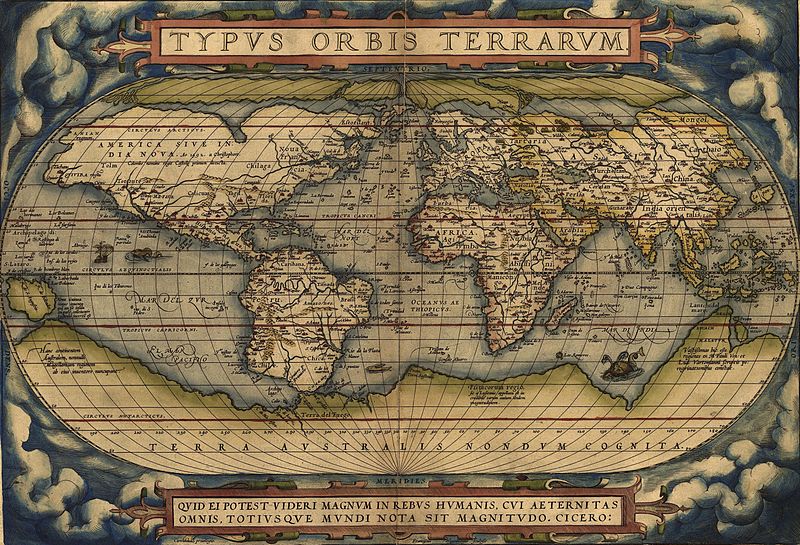
I love these relics of human progress for their aesthetic value - i.e. they look very cool - and I love them for what they represent. Maps are symbolic of the uniquely human need to create abstract models of the world we live in. Maps are our attempt to simplify a complex environment.
I also love how clearly maps show the progress of human evolution and understanding. A map of the U.S. in 1776 is significantly different from a map of the U.S. in 1820. These visual models offer a sobering reminder of the fact that "facts" change, that very few things are set in stone, and that being wrong is a prerequisite for progress.

Wednesday, October 14, 2009
Augmented Reality in Aisle 3
Augmented reality is one of the leading technological trends in the mobile communications space. This concept brings together a few different mobile-centric features - including the handset camera, the location-sensing features, and a mobile connection to the Internet - in order to deliver quite a compelling mobile service. Essentially, augmented reality allows the owner of a mobile handset (usually a smartphone such as an iPhone) to point their camera at the world around them and see an overlay of useful information through the phone's display.
This information can be purely factual - e.g. the name of the architect who designed the building in front of you. Or the information can be based on a collection of opinions, reviews, and other subjective matters - i.e. the ability to see a restaurant review by purely pointing the mobile device to the front door of the restaurant.
Where I see this technology potentially revolutionizing the we live is within the confines of shopping. For instance, the mobile phone's augmented reality features can fulfill the role of a personal shopping consultant - providing nutritional information and advice for food purchases, matching and pairing advice for clothing selection, or giving utilitarian advice when shopping for tools or construction materials. The possibilities are quite interesting and could be very innovative.
Although startups and software developers seem like the obvious catalysts for this innovation, old brick-and-mortar retailers might find that taking the early lead on this development might provide that additional spark in consumption needed to get us out of this recession.
Tuesday, October 13, 2009
Twitter Bots Kill Reputation
Twitter is clearly a fascinating phenomenon. It allows for evolutionary human traits, idiosyncrasies, absurdities, etc. to be clearly and easily displayed in 140 characters or less.
In fact, it's much more than just those 140 characters that make up a Twitter persona. The other main qualities any Twitter user has are the number of people that user follows and the number of people that follow the user. The prior describes overall engagement; the latter signifies overall popularity.
Companies have grasped these concepts rather quickly and now strive to make their Twitter personas followed by thousands of adoring fans. But what many of these fair-minded companies have realized is that it's usually pretty difficult to quickly manufacture followers. So various Twitter-"marketing" companies have sprouted touting the ability to miraculously provide thousands of fans in only a few days - for a small fee of course.
As we all know, when something valuable comes for only a small fee then things are usually not as they appear. These thousands of new fans are often bots - fake Twitter personalities created for the sole purpose of boosting the follower equation, for making it seem, at first glance, that someone or something is very popular.
(Un)fortunately, these types of shenanigans are usually quite transparent. The bots are not very good about posting realistic pictures in their profiles or communicating in natural ways - i.e. they can be spotted from a mile away. This doesn't really hurt the "marketing" companies that provide these fake masses, but instead damages the reputation of those seemingly honest companies that have these strange supporters.
So today, when I realized that a company that I've been following for months and that I felt was quite honest had gained over 35,000 fans in a week, something smelled fishy. And when I dug a little deeper I found a lot of fish - in the form of a reputation-killing digital mob. How sad.
Subscribe to:
Posts (Atom)